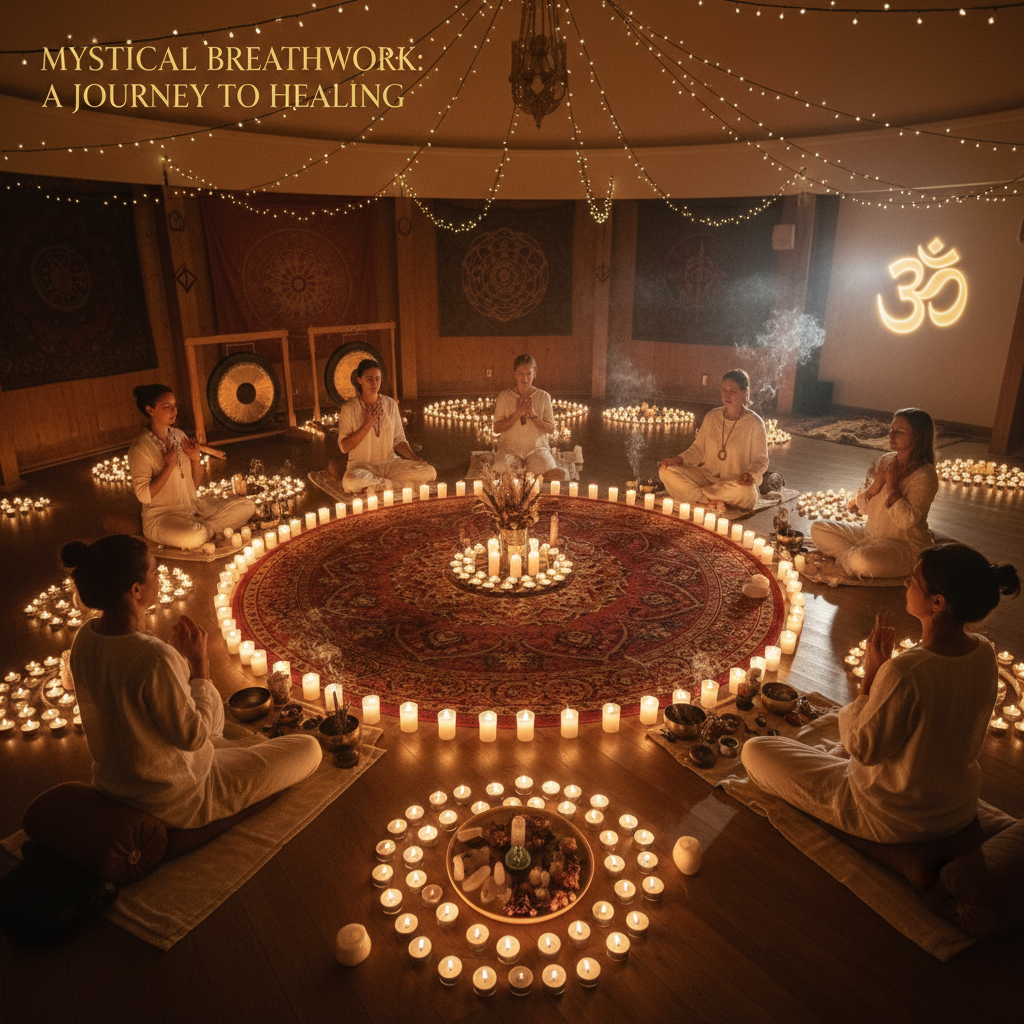
Sacred Breathwork Ceremonies: Beyond the Apps
The room held 30 strangers lying on yoga mats in the dark. Music built from quiet ambient to thundering rhythms. A facilitator moved between us, guiding our breath. For the next two hours, we would breathe together in ways that revealed parts of ourselves we didn't know existed.
This was my first ceremonial breathwork experience—and it showed me that solo practice, however powerful, is only part of the picture.
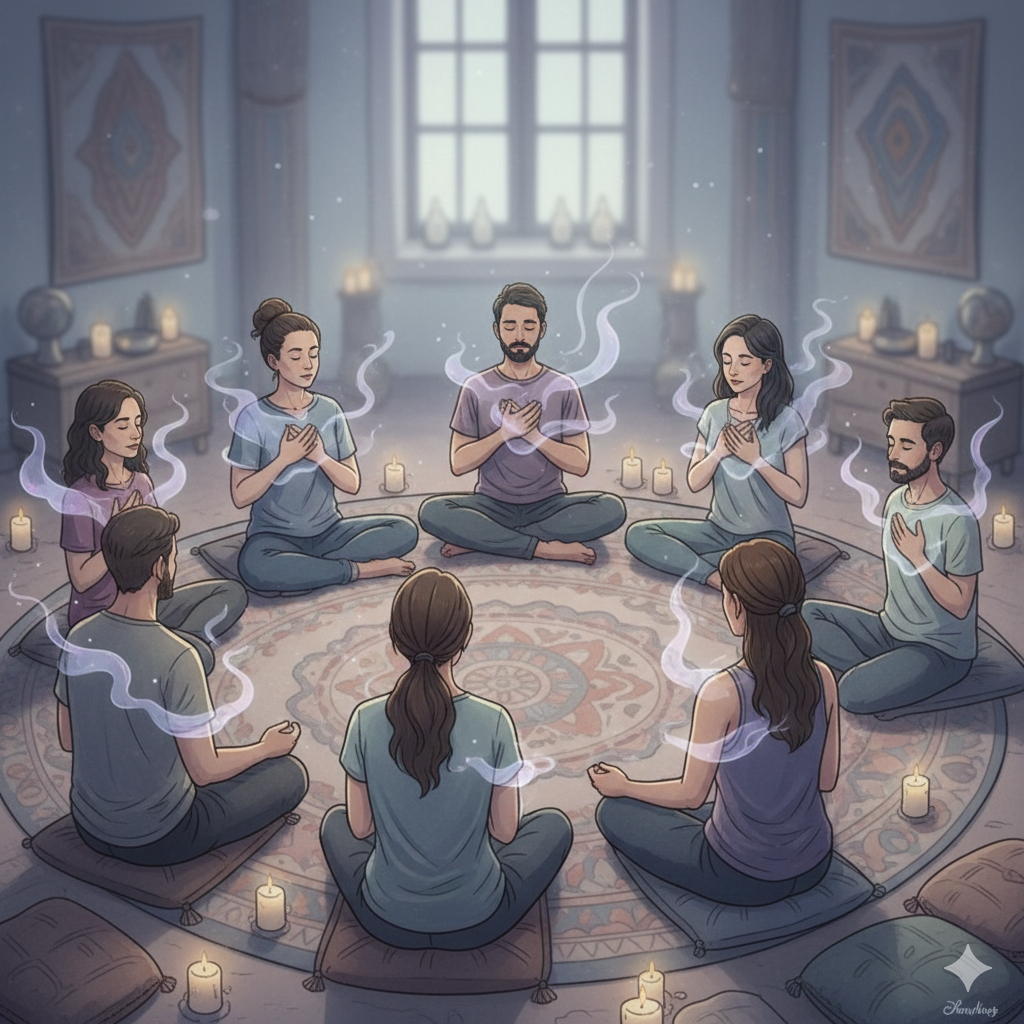 Group breathwork ceremony in a circle with soft lighting and candles, creating a peaceful, ethereal atmosphere
What Is Ceremonial Breathwork?
Ceremonial or transformational breathwork differs from daily practice in several ways:
Duration: 1-3 hours vs. 10-20 minutes Setting: Group, often with live music and facilitation Intention: Emotional processing, insight, transformation Intensity: Deep, continuous breathing patterns Support: Trained facilitators present throughout
Popular modalities include:
- Holotropic Breathwork (Stanislav Grof)
- Rebirthing (Leonard Orr)
- Transformational Breath (Judith Kravitz)
- Biodynamic Breathwork
- Shamanic Breathwork
My First Ceremony
The Setup
I signed up for a 2-hour "breathwork journey" at a retreat center outside the city. The facilitator was trained in Holotropic Breathwork but used his own eclectic approach.
Before the session:
- 30-minute introduction explaining the process
- Clear guidelines: stay on your mat, raise hand if you need support
- Eye masks provided (to go inward)
- Buckets available (emotional release can trigger nausea)
- Blankets and pillows for comfort
The facilitator was clear: "This isn't meditation. This isn't relaxation. We're going to breathe to move energy. What comes up, comes up."
The Experience
Phase 1: Building (0-30 minutes)
We began with connected breathing—continuous inhales and exhales with no pause. Mouth breathing, full and fast.
Within 10 minutes, tingling started in my hands and face. Normal. I'd felt this with Wim Hof. I continued.
By 20 minutes, the tingling spread to my entire body. My hands began to cramp—"tetany," common in intense breathwork from temporary shifts in blood chemistry.
The music intensified. I could hear others around me breathing heavily, some crying, some making sounds.
Phase 2: Release (30-75 minutes)
This is where it got strange.
Somewhere around 40 minutes, my sense of self began to shift. I wasn't unconscious—I was hyperaware—but "I" felt less solid.
Images came: memories I hadn't thought about in decades, scenes that felt symbolic rather than literal. My chest opened wide, and I felt a deep sadness arise from nowhere, followed by tears.
The facilitator encouraged us to let sounds come. Around me, the room was a symphony of human expression: sobbing, laughing, yelling, sighing.
I found myself making sounds too—deep moans I'd never made before. It felt like something was being expelled.
Phase 3: Integration (75-120 minutes)
The music softened. The facilitator guided us to slow our breath, return to normal rhythm.
I lay still for a long time, feeling like I'd just run an emotional marathon. When I finally opened my eyes, the room was quiet. People sat up slowly, many with tears still fresh.
We gathered in a circle. Some shared profound experiences—visions, insights, confrontations with past trauma. Others stayed silent, processing.
The Aftermath
Immediately after:
- Deep fatigue combined with surprising lightness
- Emotional sensitivity heightened
- Difficulty with intellectual conversation
- Desire for quiet, nature, solitude
Days following:
- Continued emotional processing
- Dreams more vivid
- Certain old patterns felt looser
- Increased capacity for tears (I'm not usually a crier)
Weeks later:
- A specific fear I'd carried for years felt diminished
- More ease with vulnerability
- Deeper daily breathwork practice
What Actually Happens?
The Physiology
Continuous, intense breathing creates several effects:
Respiratory alkalosis: Rapid expulsion of CO2 raises blood pH. This affects calcium ions, causing tingling and muscle cramping.
Altered brain states: Changes in CO2 and blood flow to the brain can create non-ordinary states of consciousness.
Autonomic activation: The sympathetic nervous system activates, then—with continued practice—can flip into parasympathetic release.
Somatic release: Physical tensions held in the body can discharge. This is why shaking, movement, and sounds often emerge.
The Psychology
Ceremonial breathwork seems to work through several mechanisms:
Bypassing cognitive defenses: The intensity of the practice can quiet the analytical mind, allowing repressed material to surface.
Somatic processing: Emotions stored as body tension can release through the physical process.
Collective field: Group energy amplifies individual experience. There's something about breathing with others that deepens the work.
Ritual container: The ceremonial structure provides safety for difficult material to emerge.
What Science Says
Research is limited but growing:
- Studies on Holotropic Breathwork show reduced anxiety and increased self-awareness
- EEG research shows changes in brain wave patterns during intense breathwork
- Case studies document significant emotional releases and shifts in chronic patterns
Critics note the placebo effect and suggest some experiences are simply hyperventilation-induced altered states. Advocates argue that the experiences are meaningful regardless of mechanism.
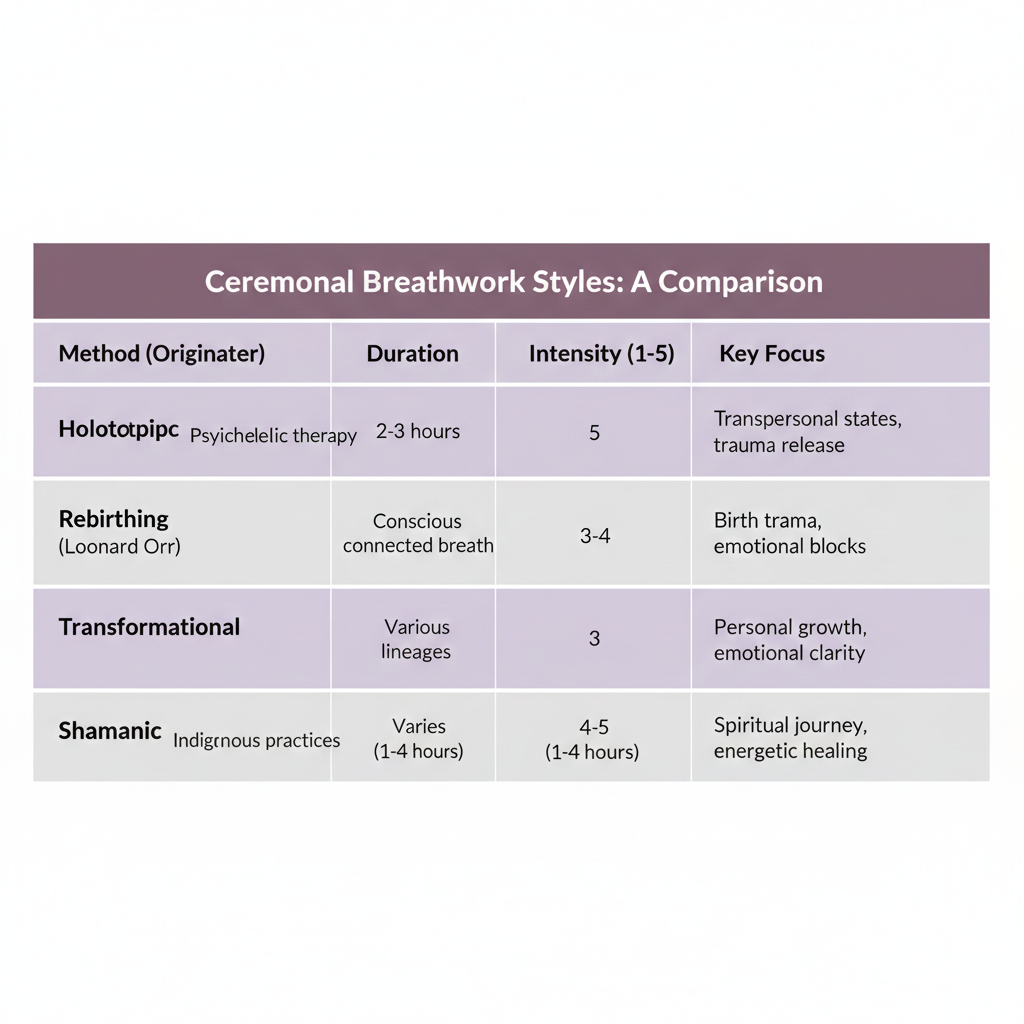 Comparison of ceremonial breathwork styles: Holotropic (Stanislav Grof), Rebirthing (Leonard Orr), Transformational, and Shamanic - with origins, duration, and intensity
Types of Breathwork Ceremonies
Holotropic Breathwork
Developed by Stanislav Grof after his LSD research was banned. Uses continuous breathing and evocative music.
Characteristics:
- Certified facilitators only
- Pairs (one breathes, one sits)
- Mandala drawing for integration
- No touching except grounding
Best for: Those wanting a structured, researched approach
Rebirthing Breathwork
Developed by Leonard Orr. Connected breathing through the nose, focused on releasing birth trauma.
Characteristics:
- Gentler than Holotropic
- Can be done in water
- Strong emphasis on birth experience
- Affirmations integrated
Best for: Those exploring early life patterns
Transformational Breath
Judith Kravitz's approach. Uses open-mouth breathing with specific body mapping.
Characteristics:
- Facilitator may touch acupressure points
- Analysis of breathing patterns
- Movement and sound encouraged
- Integration with coaching
Best for: Those wanting combined coaching and breathwork
Shamanic Breathwork
Integrates breathwork with shamanic practices: drumming, chanting, archetypal work.
Characteristics:
- Strong ritual elements
- Connection to nature/elements
- Guided journey narrative
- May include smudging, energy work
Best for: Those drawn to spiritual/shamanic traditions
Safety and Considerations
Who Should Be Cautious
Ceremonial breathwork is intense. Consider carefully if you have:
- History of psychosis or severe dissociation
- Recent heart surgery or cardiovascular issues
- Epilepsy
- Very high blood pressure
- Pregnancy
- Acute trauma (recent, unprocessed)
Always disclose your history to facilitators.
Choosing a Facilitator
Look for:
- Proper training (specific certification, not just yoga teacher training)
- Clear safety protocols
- Pre-screening for contraindications
- Integration support
- Comfortable environment
Avoid:
- Facilitators with no training background
- Large groups with no support staff
- Promises of specific outcomes
- Pressure to participate in ways that feel unsafe
What to Expect
Physical: Tingling, cramping, shaking, temperature changes, spontaneous movement Emotional: Tears, laughter, fear, joy, grief, anger—anything can arise Visual: Some people see images, colors, or have memory flashbacks Spiritual: Some report mystical experiences (whether you interpret these as real or neurological is up to you)
Ceremonial vs. Daily Practice
These aren't in competition—they complement each other.
Daily practice builds:
- Nervous system regulation
- Stress resilience
- Consistent baseline
- Technique mastery
- Measurable physiological benefits
Ceremony offers:
- Depth difficult to reach alone
- Processing of stored material
- Community and connection
- Breakthrough moments
- Perspective shifts
I now do both: daily Wim Hof and box breathing for regulation, and quarterly ceremonies for deeper work.
Finding Ceremonies
Look for:
- Local breathwork facilitators (check credentials)
- Retreat centers offering weekend workshops
- Online directories (Breathwork Professionals Network)
- Word of mouth from trusted practitioners
Expect to pay: $50-150 for group sessions, $150-300 for private
Red flags:
- No training background disclosed
- Promises of healing specific conditions
- No safety screening
- Cult-like dynamics or excessive guru devotion
Preparing for Your First Ceremony
Before:
- Eat lightly (2-3 hours before)
- Avoid alcohol and caffeine
- Set a loose intention (not a rigid expectation)
- Wear comfortable clothes
- Arrive early to settle in
During:
- Follow the facilitator's guidance
- Let whatever happens, happen
- Don't judge your experience against others
- Use sound and movement if it arises
- Ask for support if needed
After:
- Plan for rest (no big commitments)
- Journal your experience
- Stay hydrated
- Be gentle with yourself
- Consider integration support if heavy material arose
Ceremonial breathwork shows what's possible when we push beyond daily practice. Safe-Flow can help you track how these deep experiences affect your HRV and recovery in the days following—connecting the transformational to the measurable.
Join the Beta
Be among the first to experience Safe-Flow. Get early access + exclusive breathing guides.