30-Day Breathwork Challenge: My Complete Journal
I'd been practicing breathwork inconsistently for months. Good week, skip a week. Strong session, then forget for days. I decided to fix this with a commitment: 30 consecutive days of breathwork, documented in detail.
This is my complete journal—the breakthroughs, the struggles, the measurable changes, and what I learned about building a real practice.
The Rules
Daily minimum: 10 minutes of structured breathwork Tracking: HRV (morning), session notes, energy/mood ratings Techniques: Varied (Wim Hof, box breathing, 4-7-8, coherence breathing) Non-negotiable: Practice happens before anything else
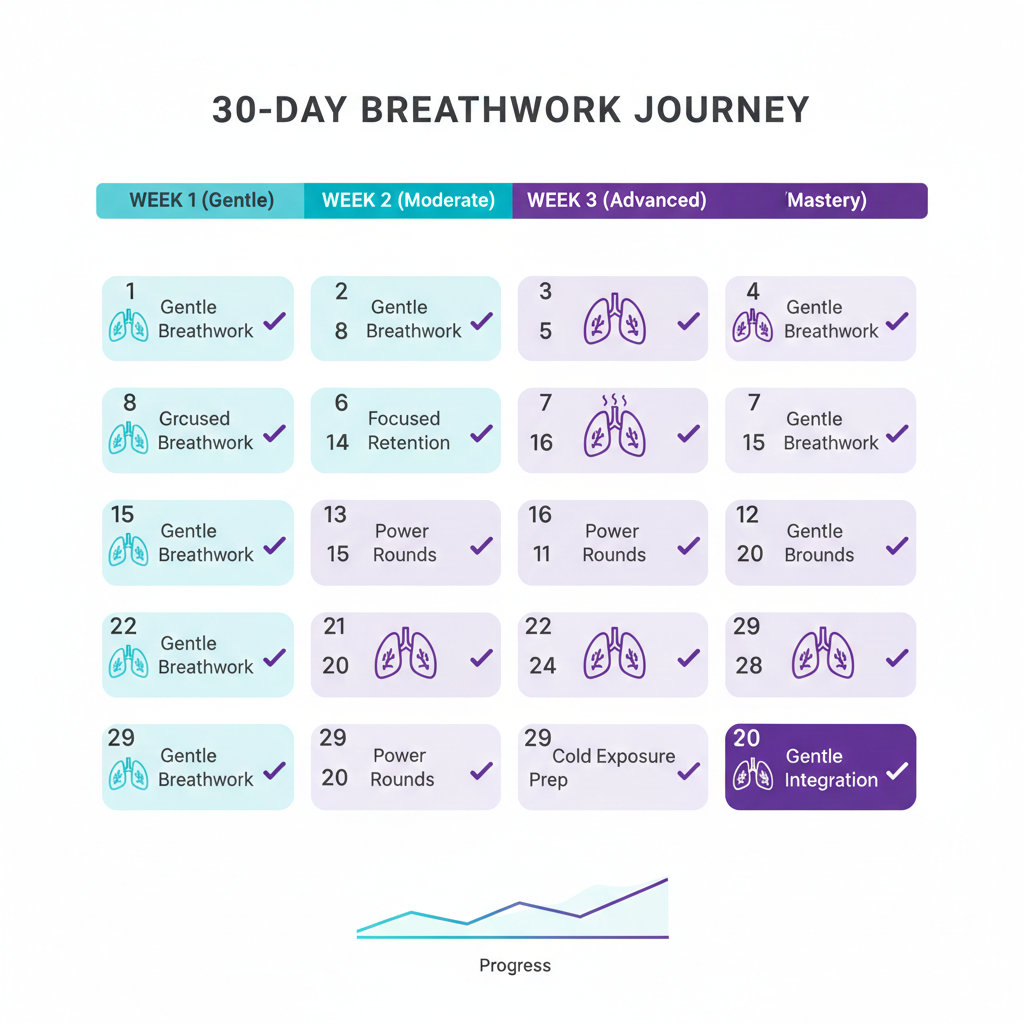 30-day breathwork challenge calendar showing daily progression from Week 1 basics through Week 4 mastery, with checkmarks tracking completion and intensity increasing over time
Week 1: The Setup
Day 1 — Starting Point
Technique: Wim Hof (3 rounds) Duration: 15 minutes Morning HRV: 42ms
First session felt great. Energy boost lasted about 2 hours. Easy to feel motivated on Day 1. The real test comes later.
Note: Baseline HRV is 42ms. This will be my comparison point.
Day 2 — Enthusiasm Continues
Technique: Box breathing (5 min) + Wim Hof (2 rounds) Duration: 18 minutes Morning HRV: 44ms
Combined techniques today. Box breathing as warmup, then Wim Hof for activation. Felt more grounded entering the day.
Day 3 — First Challenge
Technique: 4-7-8 breathing only Duration: 10 minutes (minimum) Morning HRV: 39ms
Woke up tired. Didn't want to practice. Did the minimum anyway. Felt marginally better after. This is the challenge beginning.
Day 4 — Weekend Shift
Technique: Extended Wim Hof (4 rounds) Duration: 25 minutes Morning HRV: 46ms
Weekend meant more time. Longer session, longer breath holds. Hit 2:15 on final hold—personal best. Energy excellent all day.
Day 5 — Integration
Technique: Coherence breathing (6 breaths/minute) Duration: 15 minutes Morning HRV: 48ms
Tried the calming approach today. Heart rate came down noticeably. Felt centered rather than energized. Different quality.
Day 6 — Resistance
Technique: Wim Hof (3 rounds) Duration: 12 minutes Morning HRV: 41ms
Mind made every excuse: "You've done five days, take a break." "You're tired, skip today." Did it anyway. Session was mediocre. But I showed up.
Day 7 — Week 1 Complete
Technique: Box breathing (10 min) + 4-7-8 (5 min) Duration: 15 minutes Morning HRV: 47ms
One week done. Average HRV this week: 43.9ms. Baseline was 42ms. Small improvement. More importantly: habit is forming.
Week 1 reflection: The hardest days were 3 and 6—not physically, but mentally. Resistance is sneaky. It doesn't say "quit," it says "just skip today."
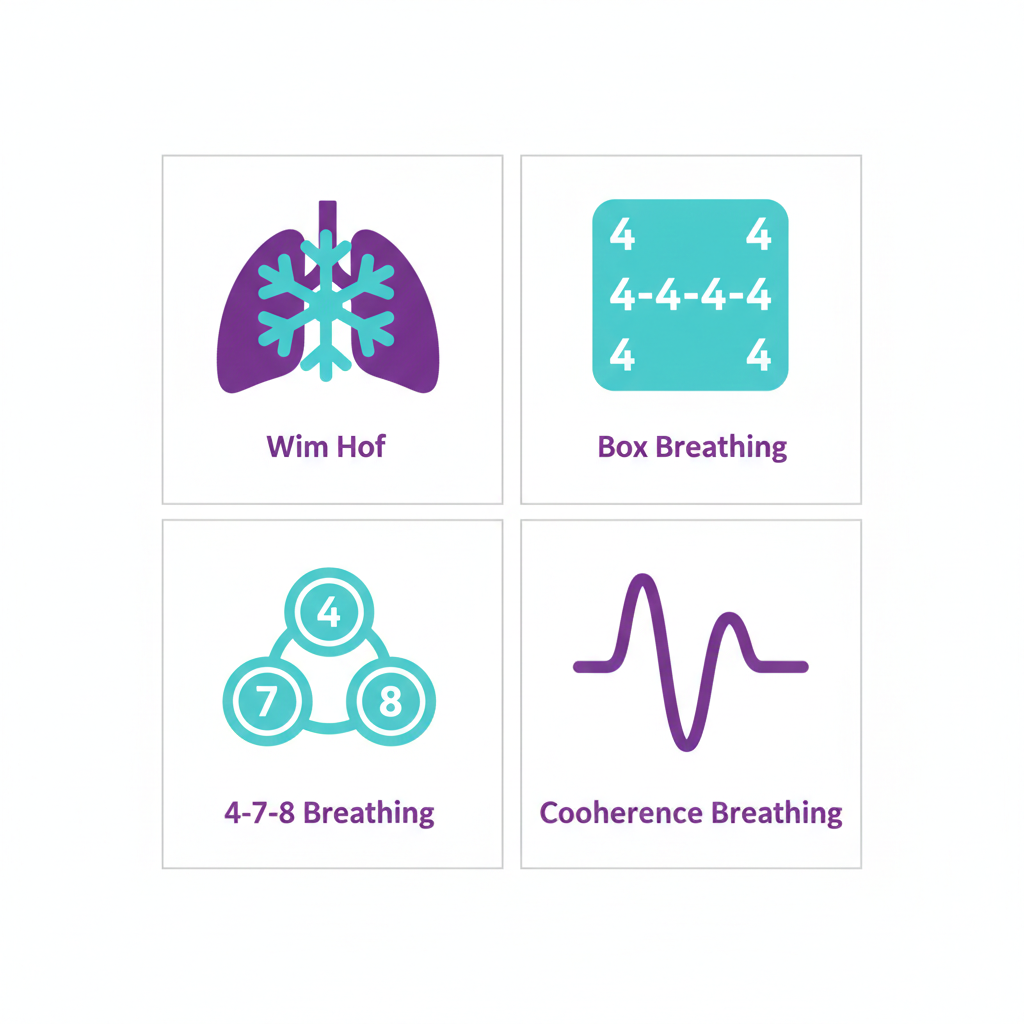 Four main breathwork techniques used in the challenge: Wim Hof Method for activation, Box Breathing for focus, 4-7-8 for relaxation, and Coherence Breathing for balance
Week 2: Finding Rhythm
Day 8 — New Pattern
Technique: Morning Wim Hof + evening 4-7-8 Duration: 20 minutes total Morning HRV: 45ms
Split the practice: activation in morning, calming at night. This feels more natural than forcing everything into one session.
Day 9 — First Miss (Almost)
Technique: 4-7-8 only Duration: 10 minutes (at 11:45 PM) Morning HRV: 43ms
Almost forgot. Did the minimum before midnight. Counts? Yes. Ideal? No. Lesson: Practice early, don't trust evening self.
Day 10 — Double Digits
Technique: Extended coherence breathing Duration: 20 minutes Morning HRV: 49ms
Ten days in. Starting to notice something: I feel "off" if I haven't practiced yet. The absence of practice is now noticeable. Good sign.
Day 11 — Experimentation
Technique: Physiological sigh intervals Duration: 12 minutes Morning HRV: 51ms
Tried the double-inhale, long-exhale pattern Huberman talks about. Used it every few minutes during a stressful call. Effective for real-time regulation.
Day 12 — Energy Shift
Technique: Wim Hof (3 rounds) Duration: 15 minutes Morning HRV: 52ms
HRV hit 52—highest reading yet. Correlation or causation? Too early to tell, but the trend is upward.
Day 13 — Boredom Appears
Technique: Box breathing Duration: 10 minutes (minimum) Morning HRV: 47ms
The practice felt mechanical. Going through motions. This is the mid-challenge valley. Commitment is tested here.
Day 14 — Week 2 Complete
Technique: Combined session (all techniques) Duration: 25 minutes Morning HRV: 50ms
Two weeks down. Average HRV this week: 48.1ms. That's a 10% improvement from baseline. Energy levels more stable. Sleep slightly better.
Week 2 reflection: Boredom is a trap. The practice doesn't always feel transformative. Sometimes it's just maintenance. That's okay.
Week 3: Deepening
Day 15 — Halfway Point
Technique: Wim Hof (4 rounds) + cold shower Duration: 20 minutes Morning HRV: 53ms
Added cold exposure after breathwork. The combination is powerful. Felt activated for hours.
Day 16 — Sick Day Test
Technique: Gentle coherence breathing only Duration: 10 minutes Morning HRV: 38ms
Felt a cold coming on. HRV dropped. Did gentle practice only—no pushing. The body needs recovery, not stress.
Day 17 — Recovery Continues
Technique: 4-7-8 + nasal breathing focus Duration: 12 minutes Morning HRV: 41ms
Still slightly sick. Focused on parasympathetic techniques. No intense breathwork. Lesson: adapt the practice to the day.
Day 18 — Back to Normal
Technique: Wim Hof (3 rounds) Duration: 15 minutes Morning HRV: 47ms
Feeling better. Standard practice resumed. Interesting note: I missed the intense breathwork while sick. The body wanted it.
Day 19 — Breakthrough Session
Technique: Extended Wim Hof (5 rounds) Duration: 30 minutes Morning HRV: 54ms
Something clicked today. Breath holds felt effortless. Hit 2:30 on final hold. Mind was completely quiet during retention. This is what people mean by "flow state."
Day 20 — Integration Day
Technique: Box breathing + journaling Duration: 15 minutes + 10 minutes journaling Morning HRV: 55ms
Combined breathwork with reflection. Wrote about patterns I've noticed over 20 days. The combination of breath and introspection feels powerful.
Day 21 — Three Weeks
Technique: Full session (all techniques) Duration: 25 minutes Morning HRV: 56ms
Three weeks complete. Average HRV this week: 49.1ms (despite sick days). The upward trend continues. More importantly: this feels like habit now, not discipline.
Week 3 reflection: The practice adapts to life. Sick days don't break the streak—they modify it. Flexibility keeps consistency possible.
Week 4: Mastery
Day 22 — Natural Practice
Technique: Intuitive (no set protocol) Duration: 18 minutes Morning HRV: 54ms
Didn't plan a technique. Just started breathing and followed what felt right. Ended up doing a mix of everything. Maybe that's what mastery looks like.
Day 23 — Teaching Others
Technique: Wim Hof (guided a friend) Duration: 20 minutes Morning HRV: 52ms
Taught the basics to a friend. Teaching clarified my own understanding. Had to articulate what I do automatically now.
Day 24 — Morning Resistance Returns
Technique: 4-7-8 only Duration: 10 minutes Morning HRV: 48ms
Didn't want to practice. Did minimum anyway. Fourth week still has resistance days. Habit doesn't mean automatic.
Day 25 — Evening Shift
Technique: Coherence breathing Duration: 15 minutes Morning HRV: 53ms
Moved practice to evening. Better for today's schedule. The flexibility is there now. Practice happens regardless of timing.
Day 26 — Measurable Changes
Technique: Wim Hof (3 rounds) Duration: 15 minutes Morning HRV: 57ms
Reviewed all data. Clear trends: HRV up ~35% from baseline. Breath holds improved 40%. Subjective energy rating average: 7.2/10 (was 5.8/10 in week 1).
Day 27 — Simplification
Technique: Nasal breathing awareness only Duration: 20 minutes Morning HRV: 55ms
No fancy technique. Just sat and breathed through my nose, paying attention. Sometimes the simplest practice is the most profound.
Day 28 — Final Push
Technique: Extended everything Duration: 35 minutes Morning HRV: 58ms
Longest session of the challenge. 5 rounds of Wim Hof, then 10 minutes of coherence breathing. Felt fully present afterward.
Day 29 — Penultimate Day
Technique: Box breathing Duration: 15 minutes Morning HRV: 56ms
One day left. Reflecting on the journey. This practice is now part of my identity, not just something I "do."
Day 30 — Complete
Technique: Full celebration session Duration: 30 minutes Morning HRV: 59ms
Day 30. Final HRV reading: 59ms. Baseline was 42ms. That's a 40% improvement. Finished with gratitude for the breath itself.
The Results
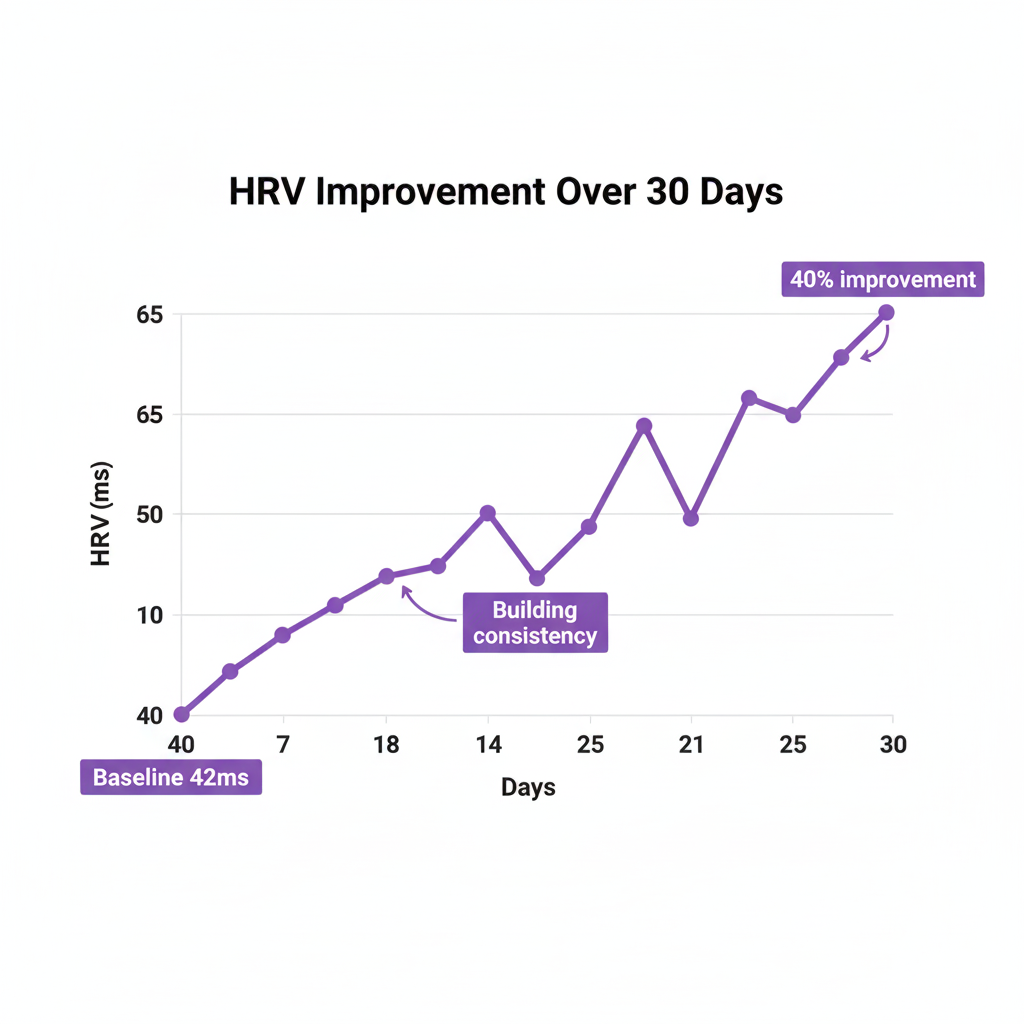 HRV progression over 30 days: starting at 42ms baseline, trending upward with natural fluctuations, reaching 59ms by Day 30—a 40% improvement in heart rate variability
Quantifiable Changes
| Metric | Day 1 | Day 30 | Change |
|---|---|---|---|
| Morning HRV | 42ms | 59ms | +40% |
| Max breath hold | 1:45 | 2:35 | +48% |
| Resting heart rate | 68 bpm | 62 bpm | -9% |
| Self-rated energy | 5.8/10 | 7.6/10 | +31% |
| Days with headache | 4/week | 1/week | -75% |
Qualitative Changes
Sleep: Falling asleep faster, waking more refreshed Stress response: More space between trigger and reaction Focus: Longer stretches of concentrated work Physical: Cold tolerance improved, baseline calm higher Mental: Less rumination, more present-moment awareness
Key Lessons
1. Minimum Is Enough
On hard days, 10 minutes counts. Don't let perfectionism kill consistency. A small practice beats no practice every time.
2. Adaptation Is Key
Sick? Do gentle breathing. Energized? Do intense work. Bored? Try a new technique. The practice must flex to survive.
3. Track Something
HRV gave me objective feedback. Without data, I'd rely only on feelings—which can be misleading. Measurement creates motivation.
4. Morning Wins
Evening practice happened sometimes, but morning practice was more reliable. Front-load the non-negotiable.
5. Community Helps
Telling others I was doing this challenge created accountability. Teaching a friend deepened my practice. Don't isolate.
6. Resistance Never Fully Disappears
Day 24 I still didn't want to practice. Habit reduces friction but doesn't eliminate it. Show up anyway.
7. The Changes Are Real
This isn't placebo. HRV, heart rate, breath holds—these are measurable. Consistent breathwork creates measurable physiological adaptation.
What's Next
The 30-day challenge is complete, but the practice continues. Here's my ongoing commitment:
- Daily minimum: 10 minutes remains non-negotiable
- Tracking: Weekly HRV averages instead of daily
- Variation: Trying new techniques monthly
- Community: Monthly group breathwork sessions
The challenge created the habit. Now the habit sustains itself.
Ready to start your own challenge? Safe-Flow helps you track HRV, session consistency, and progress over time—turning your breathwork commitment into measurable results.
Join the Beta
Be among the first to experience Safe-Flow. Get early access + exclusive breathing guides.