Oxygen Advantage: The Counterintuitive Approach to Better Breathing
While most breathwork methods focus on breathing more, Patrick McKeown's Oxygen Advantage takes the opposite approach: breathe less, breathe better. This comprehensive review explores the method, its science, and how it compares to other popular techniques.
Who Is Patrick McKeown?
Patrick McKeown is an Irish author and breathing educator who:
- Trained directly with Dr. Konstantin Buteyko (creator of the Buteyko Method)
- Authored multiple books including "The Oxygen Advantage" and "Atomic Focus"
- Works with elite athletes, military personnel, and corporate clients
- Developed the BOLT (Body Oxygen Level Test) score
His approach bridges traditional Buteyko breathing with sports science and modern research.
The Core Philosophy
The Paradox: Less Is More
Most people assume that breathing more means more oxygen. McKeown argues the opposite:
Chronic over-breathing leads to:
- Lower CO2 levels in the blood
- Reduced oxygen delivery to tissues (Bohr effect)
- Constricted blood vessels and airways
- Increased stress response
Breathing less leads to:
- Higher CO2 tolerance
- Better oxygen delivery
- Dilated blood vessels
- Calmer nervous system
This is why you can feel breathless even when your blood oxygen is at 99%.
Key Concepts
1. The BOLT Score
BOLT (Body Oxygen Level Test) measures CO2 tolerance:
How to measure:
- Breathe normally through your nose
- After a normal exhale, pinch your nose
- Time how long until you feel the first urge to breathe
- This is NOT a maximum breath hold
Interpreting your score:
- Below 10 seconds: Poor tolerance, likely over-breather
- 10-20 seconds: Room for improvement
- 20-30 seconds: Good baseline
- 30-40 seconds: Very good
- Above 40 seconds: Excellent (elite athlete level)
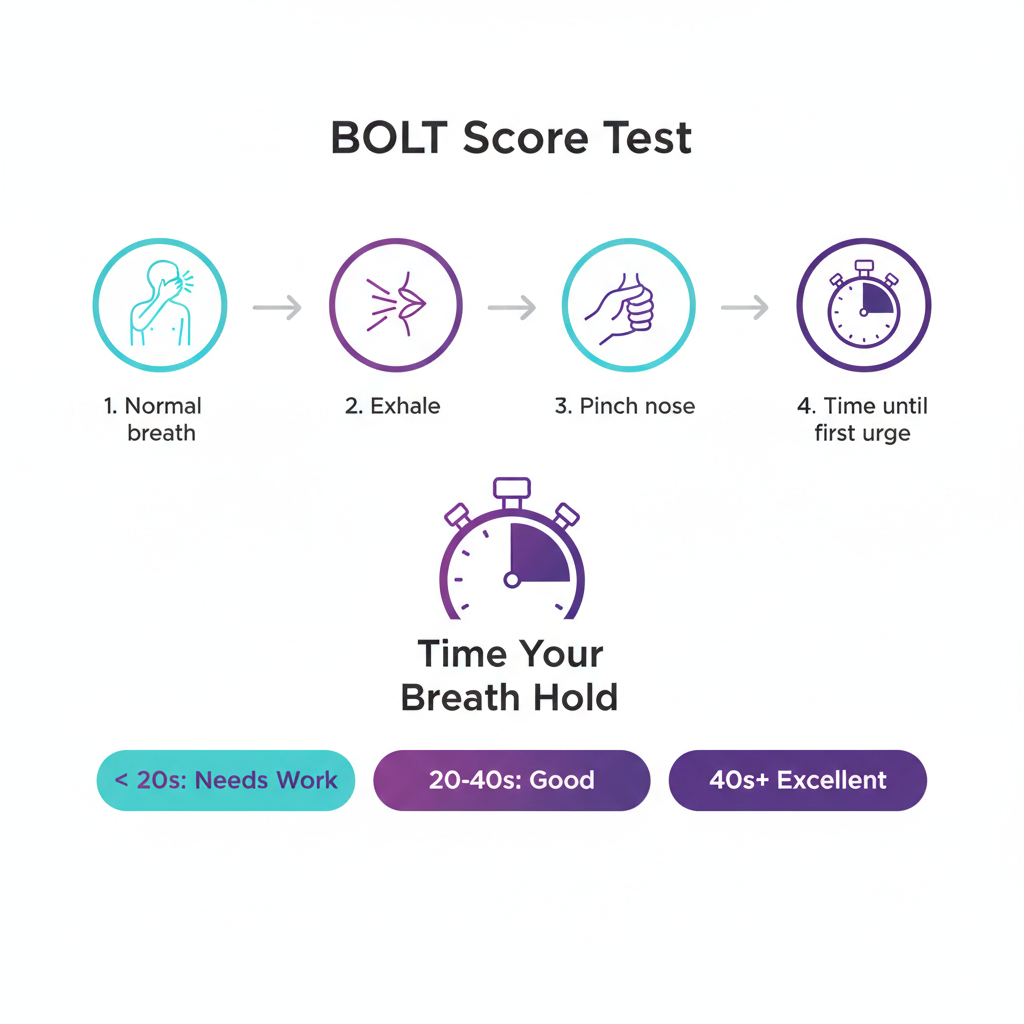 BOLT score test infographic: step-by-step instructions with score ranges - under 20s needs work, 20-40s good, 40s+ excellent
2. Nasal Breathing Always
McKeown is emphatic: breathe through your nose 24/7, including during sleep and exercise.
Why nose breathing matters:
- Filters, warms, and humidifies air
- Produces nitric oxide
- Regulates breathing volume
- Activates the diaphragm properly
3. Light Breathing
The goal is to breathe so gently that:
- You can't hear yourself breathe
- You can barely feel air entering your nostrils
- Your breathing is slow and rhythmic
This trains CO2 tolerance and reduces chronic hyperventilation.
The Oxygen Advantage Exercises
Exercise 1: Breathe Light to Breathe Right
Purpose: Reduce breathing volume
How to do it:
- Sit comfortably, relax
- Breathe through your nose
- Gradually reduce the size of each breath
- Create a tolerable feeling of air hunger
- Maintain for 3-5 minutes
When to use: Morning routine, before bed, during stress
Exercise 2: Nose Unblocking Exercise
Purpose: Clear congestion, open airways
How to do it:
- Take a small breath through your nose
- Pinch your nose and hold your breath
- Walk around while holding (20-30 steps)
- When you need to breathe, release and breathe calmly through nose
- Wait 30 seconds, repeat 5-6 times
When to use: When congested, before exercise
Exercise 3: Breath Hold Walking
Purpose: Build CO2 tolerance, improve athletic performance
How to do it:
- Walk at a normal pace
- After a normal exhale, hold your breath
- Continue walking while holding
- When you feel a medium-to-strong air hunger, resume nasal breathing
- Recover, repeat
When to use: Training sessions, building tolerance
Exercise 4: Simulate High Altitude Training
Purpose: Trigger EPO release, improve oxygen-carrying capacity
How to do it:
- Exhale normally, hold breath
- Walk as many steps as possible (aim for 80-100)
- You should feel strong air hunger
- Recover fully between sets
- Do 8-10 sets
When to use: Athletic performance enhancement
Comparing Methods
Oxygen Advantage vs. Wim Hof
| Aspect | Oxygen Advantage | Wim Hof |
|---|---|---|
| Breathing volume | Less is more | More then hold |
| CO2 approach | Build tolerance | Temporarily deplete |
| Primary effect | Parasympathetic | Sympathetic first |
| Intensity | Gentle, subtle | Intense, energizing |
| Best for | Daily life, athletics | Energy, cold tolerance |
| Risk level | Very low | Moderate (if done wrong) |
Can they work together? Yes. Many practitioners use:
- Oxygen Advantage principles for daily life
- Wim Hof for specific activation/cold exposure
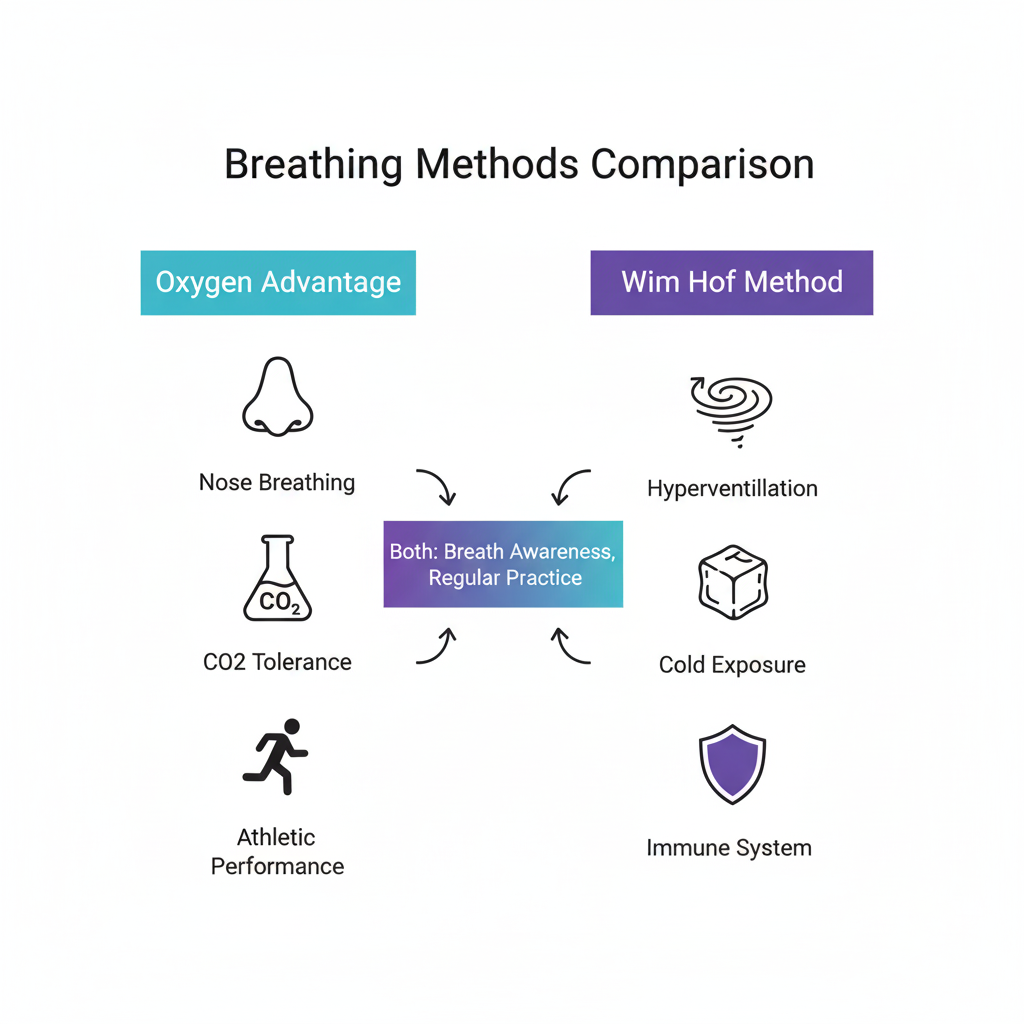 Side-by-side comparison: Oxygen Advantage (nose breathing, CO2 tolerance, athletic performance) vs Wim Hof Method (hyperventilation, cold exposure, immune system)
Oxygen Advantage vs. Box Breathing
| Aspect | Oxygen Advantage | Box Breathing |
|---|---|---|
| Breath holds | Long, building | Short, equal |
| Goal | CO2 tolerance | Calm, balance |
| Complexity | Multiple exercises | Single technique |
| Time needed | Varies | 4-5 minutes |
| Best for | Long-term adaptation | Acute stress relief |
Who Benefits Most?
Athletes
McKeown works extensively with athletes. Benefits include:
- Improved VO2 max
- Better anaerobic threshold
- Reduced exercise-induced asthma
- Enhanced recovery
Notable users: UFC fighters, Olympic athletes, professional soccer players
People with Breathing Issues
- Asthma (many report reduced symptoms)
- Sleep apnea
- Chronic mouth breathers
- Anxiety-related breathing dysfunction
Everyday Optimization
- Better sleep quality
- Reduced stress response
- Improved focus
- More energy throughout the day
Criticisms and Limitations
Fair criticisms:
- Less exciting - Compared to Wim Hof, it's subtle and takes patience
- Hard to verify - Some claims are difficult to test rigorously
- Not for everyone - Some conditions may not respond
- Requires consistency - Results come slowly
Unfair criticisms:
- "It's just breathing less" - It's a comprehensive system
- "CO2 is waste" - CO2 is a vital regulator of oxygen delivery
Getting Started
Week 1: Awareness
- Measure your BOLT score daily
- Notice when you mouth breathe
- Start gentle nasal breathing focus
Week 2: Light Breathing
- Practice "breathe light" 10 minutes/day
- Tape mouth during sleep (if appropriate)
- Continue BOLT measurements
Week 3-4: Integration
- Add breath hold walking
- Nasal breathe during easy exercise
- Track BOLT improvements
Month 2+: Advanced
- Simulate altitude training
- Nasal breathing during harder exercise
- Target BOLT score above 30
Resources
Books:
- "The Oxygen Advantage" (main text)
- "Atomic Focus" (focus-oriented)
- "The Breathing Cure" (health focus)
Online:
- OxygenAdvantage.com
- Certified instructor directory
- Online courses
App:
- Oxygen Advantage app (free breathing exercises)
The Bottom Line
Oxygen Advantage isn't as flashy as some breathwork methods, but it may be the most practical for daily life improvement. The principles—nose breathing, light breathing, CO2 tolerance—can transform how you feel all day, every day.
Best for:
- Long-term health optimization
- Athletic performance
- People who've tried "more breathing" without results
Rating: 4.5/5
Want to track how Oxygen Advantage principles affect your biometrics? Safe-Flow helps you monitor HRV, recovery, and stress levels as you implement these techniques—showing you the real impact of breathing less.
Join the Beta
Be among the first to experience Safe-Flow. Get early access + exclusive breathing guides.